Introduction
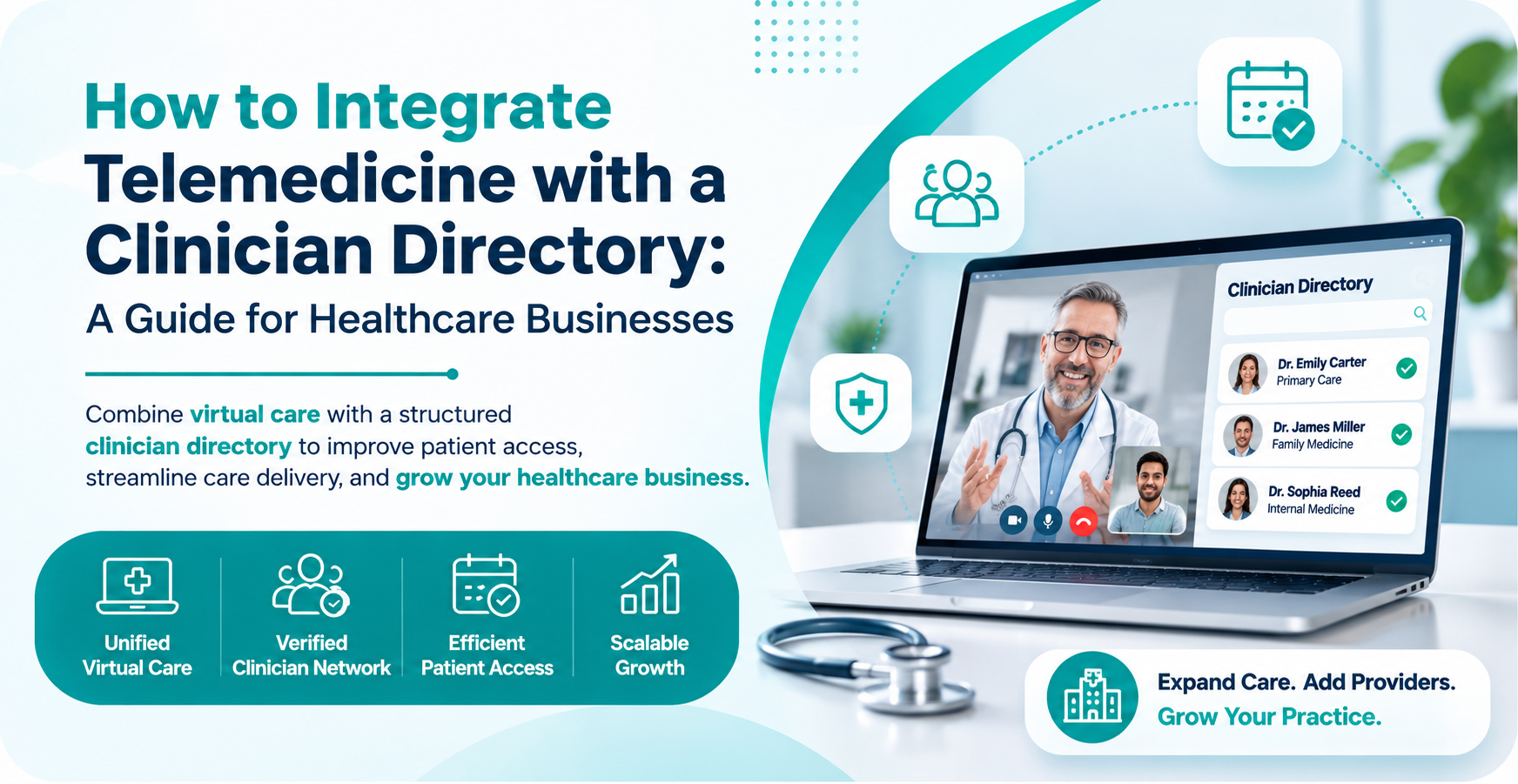
Telemedicine has transformed how healthcare organizations connect patients with healthcare professionals. As virtual healthcare services continue to expand, healthcare businesses need more than video consultation capabilities. They also need an organized way to manage clinicians, display provider information, coordinate appointments, and connect patients with appropriate healthcare professionals.
Integrating telemedicine with a clinician directory creates a connected digital healthcare environment where patients can discover available clinicians, review their qualifications, check availability, and access virtual consultations through a unified platform.
For telehealth startups, clinics, hospitals, and digital health companies, telemedicine clinician directory integration can improve provider management, simplify appointment coordination, and support scalable virtual care delivery.
This guide explains how to integrate a clinician directory with a telemedicine platform, the essential features involved, and the benefits for healthcare businesses.
How Telemedicine Platforms Integrate with Clinician Directories
Telemedicine and clinician directory integration refers to connecting a healthcare provider directory with a telehealth platform so that patients can discover clinicians, review their profiles, check availability, and access virtual healthcare services.
A clinician directory typically contains information such as:
- Clinician names and professional qualifications
- Medical specialties and areas of expertise
- Professional credentials and licensing information
- Consultation availability and scheduling details
- Languages supported and service locations
- Accepted consultation types, such as video or audio
When connected with telemedicine software, this information becomes part of the patient access and consultation workflow.
For example, a patient visiting a healthcare platform can browse available clinicians, select a suitable provider, book an appointment, and join a virtual consultation. Healthcare administrators can manage provider information and coordinate operational workflows through connected systems.
This approach helps healthcare businesses establish a more organized clinician directory for telehealth platforms.
Why Healthcare Businesses Need an Integrated Clinician Directory
Managing clinician information separately from telemedicine services can create operational challenges. Provider availability may not be updated consistently, appointment scheduling can become complicated, and patients may find it difficult to identify the appropriate healthcare professional.
An integrated clinician directory helps healthcare organizations establish a more connected provider management process.
Healthcare organizations looking to expand their virtual care services should understand the importance of building a reliable clinician network for telehealth platforms. Integrating verified healthcare providers, specialty coverage, and appointment scheduling into a unified system helps businesses improve provider management and deliver connected virtual care services. A well-structured clinician network for telehealth also enables healthcare businesses to scale their provider operations while connecting patients with qualified clinicians through an integrated telemedicine platform.
1. Simplified Clinician Discovery
Patients can browse clinician profiles based on specialties, qualifications, languages, and other relevant information. This helps them identify healthcare professionals who match their consultation requirements.
A structured telehealth provider directory also makes it easier for healthcare businesses to organize their provider information and improve patient access.
2. Better Appointment Coordination
Connecting clinician availability with appointment scheduling helps reduce manual coordination. Patients can view available appointment slots and select suitable consultation times.
This integration can also help healthcare administrators manage appointments across multiple clinicians and specialties.
3. Centralized Provider Management
Healthcare administrators can manage clinician profiles, professional information, specialties, and availability through a centralized system.
A clinician management system can help organizations maintain consistent provider information and simplify administrative workflows.
4. Connected Virtual Consultations
Integrating the directory with telemedicine capabilities allows patients to move from clinician discovery to appointment booking and virtual consultation without navigating disconnected systems.
This creates a more connected patient journey and supports efficient virtual care delivery.
5. Scalable Healthcare Operations
As healthcare businesses expand their provider networks, an integrated system can support additional clinicians, specialties, and consultation services without relying entirely on manual processes.
Key Components of Telemedicine and Clinician Directory Integration
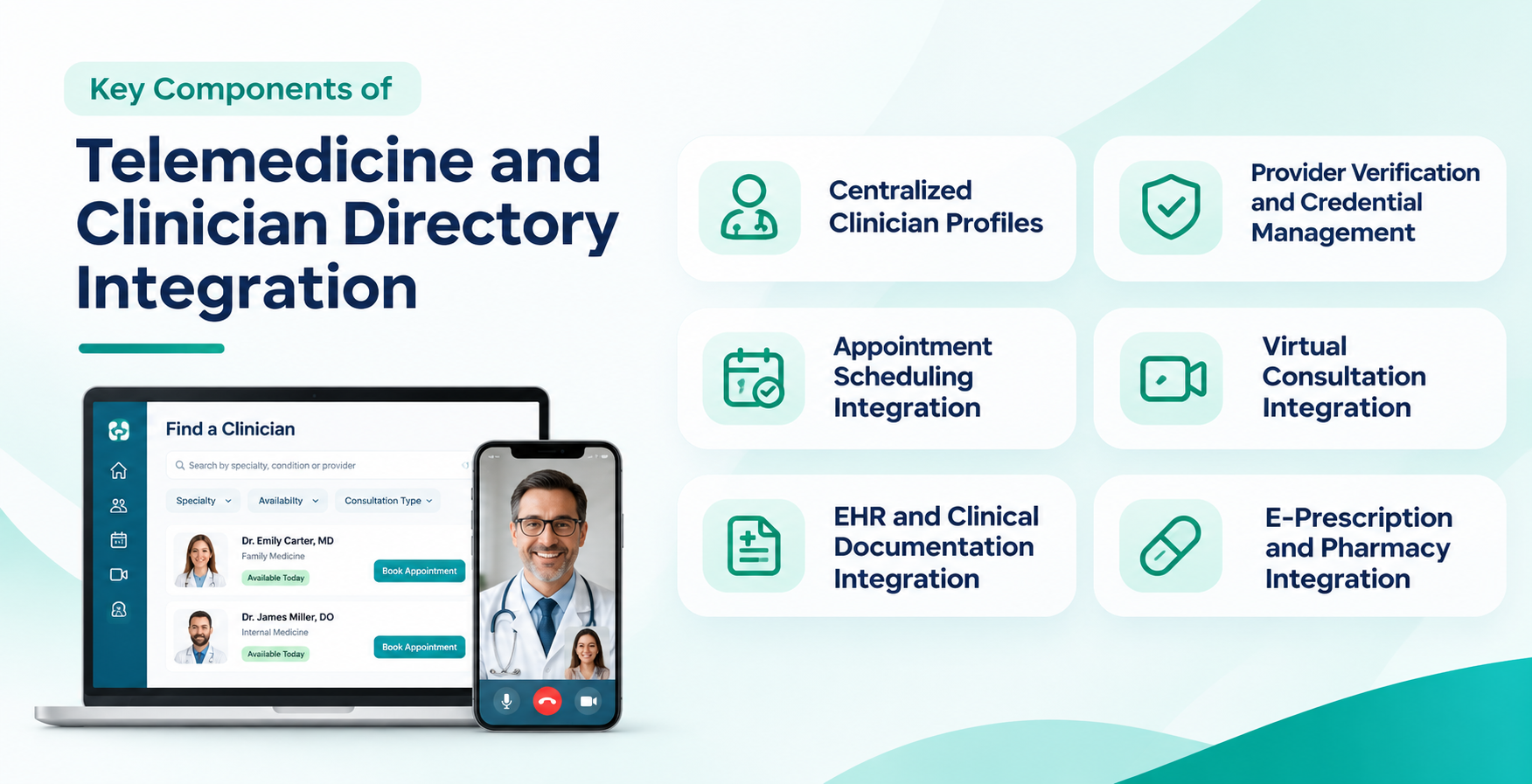
A successful telemedicine software integration requires several connected components that support provider discovery, patient access, and clinical workflows.
1. Centralized Clinician Profiles
A clinician profile should provide relevant information that helps patients understand a provider’s qualifications and services.
Important profile fields include:
- Full name and professional designation
- Medical specialty and qualifications
- Professional experience
- License and credential information
- Consultation availability
- Languages spoken
- Consultation modalities
A centralized clinician profile system helps healthcare organizations maintain consistent provider information across their digital healthcare platform.
2. Provider Verification and Credential Management
Healthcare organizations should establish processes for verifying clinician credentials and maintaining accurate professional information.
Depending on the organization’s operating model, verification workflows may include license checks, qualification reviews, credential documentation, and periodic updates.
For healthcare businesses operating across multiple US states, provider licensing and eligibility to practice should be considered when displaying clinicians and assigning consultations.
3. Appointment Scheduling Integration
Appointment scheduling connects clinician availability with patient booking workflows.
When integrated properly, the system can support:
- Real-time or synchronized availability
- Appointment slot selection
- Booking confirmations
- Appointment reminders
- Rescheduling and cancellations
- Provider-specific scheduling rules
This helps reduce scheduling conflicts and improves coordination between patients and clinicians.
4. Virtual Consultation Integration
The telemedicine component enables patients and clinicians to connect through virtual consultation tools.
Depending on the platform’s capabilities, this may include video consultations, audio calls, secure messaging, and digital waiting rooms.
Connecting consultation access with clinician profiles creates a consistent experience from provider discovery to virtual care delivery.
5. EHR and Clinical Documentation Integration
Integrating electronic health record capabilities can help healthcare organizations manage patient information and clinical documentation within connected workflows.
Depending on the implementation, the platform may support patient histories, clinical notes, encounter records, and other relevant healthcare information.
Appropriate access controls, privacy safeguards, and interoperability standards should be considered when connecting these systems. Healthcare businesses can also explore Electronic Health Record (EHR) solutions to understand how electronic records support connected clinical workflows.
6. E-Prescription and Pharmacy Integration
For eligible consultations, electronic prescribing capabilities can connect clinical workflows with prescription management.
Depending on the healthcare organization’s services and applicable regulations, integrations may support prescription transmission, pharmacy connectivity, and medication-related workflows.
This creates a more connected digital healthcare experience while keeping prescribing decisions under the responsibility of authorized healthcare professionals.
Explore electronic prescription solutions to learn more about connected prescribing workflows.
How to Integrate a Clinician Directory with a Telemedicine Platform
Healthcare businesses should approach integration with a structured implementation plan. The following steps help organizations connect clinician management and virtual consultation capabilities.
Step 1: Define Your Provider Directory Requirements
Start by identifying the information and functionality required for the clinician directory.
Determine which specialties, provider qualifications, consultation types, languages, and geographic coverage need to be supported.
Healthcare businesses should also identify whether the directory will serve patients, administrators, or both.
Step 2: Organize Clinician Profiles
Create standardized clinician profiles with accurate professional information, qualifications, specialties, and availability.
Establish a process for updating provider records and reviewing credential information to maintain directory accuracy.
Step 3: Connect the Scheduling System
Integrate clinician availability with the appointment scheduling system. Ensure that booking information is synchronized appropriately to minimize scheduling conflicts.
Step 4: Integrate Virtual Consultation Capabilities
Connect the clinician directory with the telemedicine consultation environment.
Patients should be able to move from selecting a clinician to accessing their scheduled consultation through a straightforward workflow.
Step 5: Connect EHR and Other Healthcare Systems
Evaluate integrations with electronic health records, clinical documentation, e-prescribing, laboratory services, and other healthcare systems based on business requirements.
Use appropriate interoperability standards and secure integration methods wherever applicable.
Healthcare businesses can explore healthcare integrations to understand how connected systems support digital healthcare operations.
Step 6: Test and Monitor the Integration
Before deployment, test clinician profiles, provider availability, appointment booking, consultation access, and connected workflows.
Monitor integration performance, data accuracy, system availability, and user experience after launch.
Benefits of Integrating Telemedicine with a Clinician Directory for Healthcare Businesses
An integrated clinician directory can provide operational and patient access benefits for healthcare organizations.
1. Improved Patient Access
Patients can discover relevant clinicians and access virtual consultations through a connected platform.
2. Efficient Provider Management
Centralized clinician information helps administrators maintain provider records and coordinate availability.
3. Streamlined Appointment Scheduling
Connected appointment management can reduce manual booking activities and scheduling inconsistencies.
4. Connected Clinical Workflows
Integrating consultations with clinical documentation, prescriptions, and other healthcare services can support more coordinated operations.
5. Business Scalability
Healthcare startups and established organizations can expand their provider networks and digital healthcare services through a unified technology infrastructure.
How DrCare247 Supports Integrated Telemedicine Workflows
Healthcare businesses looking to launch or expand virtual care services need technology that connects provider networks with essential healthcare operations.
DrCare247 provides telemedicine infrastructure designed to support healthcare businesses, digital health companies, and organizations developing virtual care services.
Its platform capabilities include telemedicine software, physician network support, EHR connectivity, electronic prescribing, and healthcare integrations.
By connecting clinician management with virtual consultation workflows and supporting healthcare services, DrCare247 helps organizations build a more connected digital healthcare environment.
Healthcare businesses can explore DrCare247’s physician network to learn more about clinician network capabilities and telemedicine platform solutions for virtual healthcare infrastructure.
Organizations can also explore healthcare integrations, EHR solutions, and electronic prescription capabilities to understand how connected healthcare technology supports their operations.
For healthcare startups and organizations building branded digital healthcare services, white-label telehealth solutions can also be explored.
Conclusion
Integrating telemedicine with a clinician directory helps healthcare organizations connect provider discovery, appointment scheduling, and virtual consultations within a unified digital healthcare environment.
For telehealth startups, clinics, hospitals, and digital health businesses, this integration can simplify clinician management, improve patient access, and support scalable virtual care delivery.
With connected capabilities for telemedicine, physician networks, EHR, and electronic prescribing, DrCare247 supports healthcare businesses looking to establish and expand their digital healthcare operations.