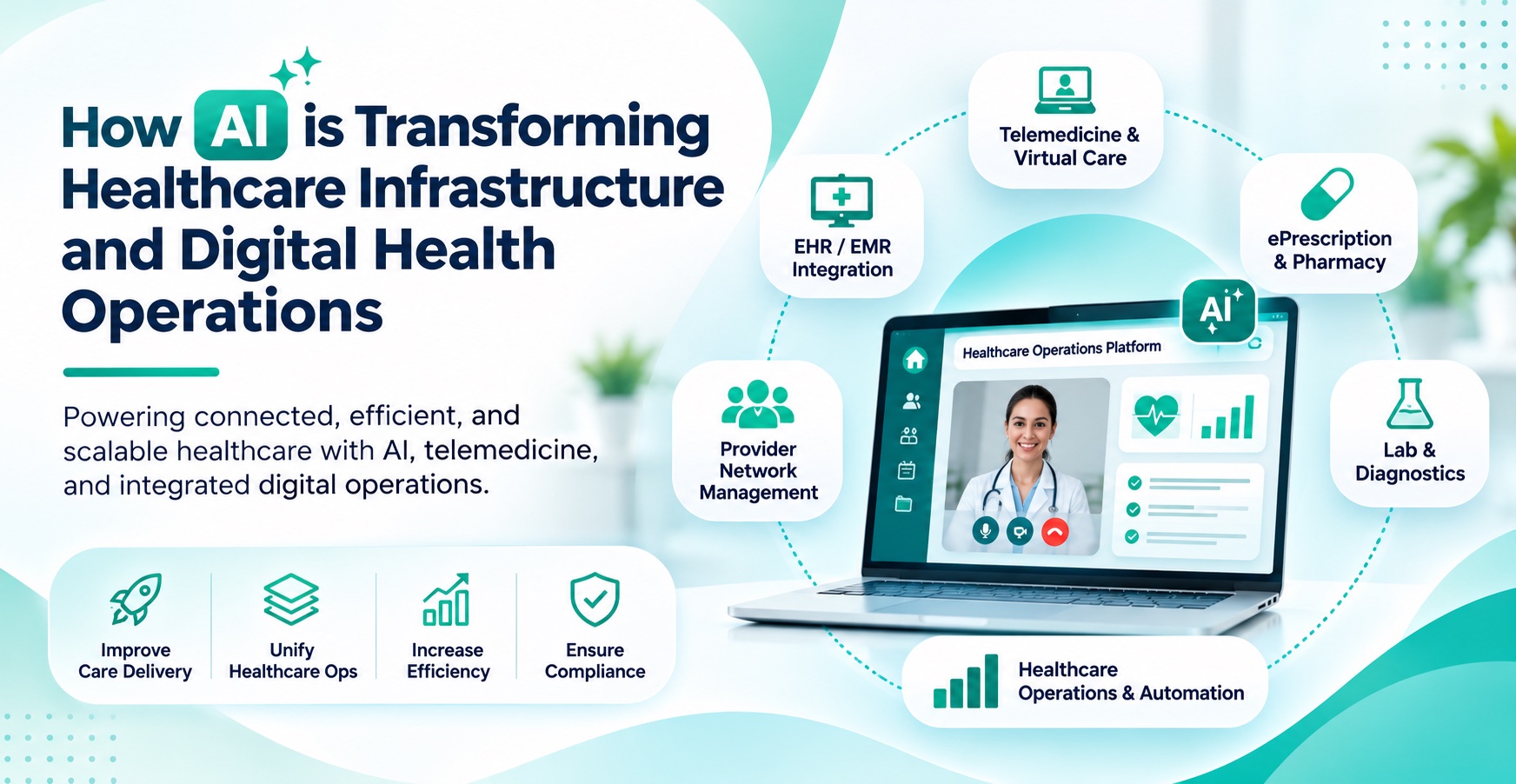
Artificial intelligence is becoming an important part of modern healthcare technology. From automating administrative processes to supporting clinical documentation, AI is creating new opportunities for healthcare organizations to improve operational efficiency and strengthen digital healthcare infrastructure.
As healthcare businesses expand their digital services, managing multiple technology systems has become increasingly complex. Telemedicine platforms, Electronic Health Records (EHR), pharmacy networks, laboratory systems, and patient management applications must work together to support connected healthcare operations.
AI can help organizations make these systems more intelligent, efficient, and responsive.
However, successful AI adoption requires more than implementing standalone tools. Healthcare businesses also need reliable infrastructure, secure data exchange, interoperability, and scalable technology platforms.
Let’s explore the major areas where AI is transforming healthcare infrastructure and digital health operations.
The Growing Importance of AI in Healthcare Infrastructure
Healthcare infrastructure includes the software, systems, networks, and digital processes that support healthcare delivery and business operations.
Traditional healthcare environments often depend on multiple independent applications. This can create challenges such as fragmented patient information, repetitive administrative work, and inefficient communication between departments.
AI introduces intelligent capabilities that can enhance existing healthcare technology environments.
Some important applications include:
- Automated administrative workflows.
- AI-assisted clinical documentation.
- Predictive analytics for operational planning.
- Intelligent patient communication.
- Data analysis and workflow optimization.
- Automated information processing.
For healthcare technology providers, integrating AI into existing infrastructure can create opportunities to deliver more efficient digital healthcare services.
Key Applications of AI in Digital Health Operations
1. AI-Powered Clinical Documentation
Clinical documentation is an essential part of healthcare operations, but preparing and maintaining medical records can require significant administrative time.
AI medical scribes can assist healthcare professionals by converting clinical conversations into structured draft documentation.
Potential applications include:
- Preparing clinical note drafts.
- Organizing consultation information.
- Supporting documentation workflows.
- Reducing repetitive manual data entry.
Human review remains essential to ensure clinical accuracy and appropriate documentation.
2. Healthcare Workflow Automation
Healthcare organizations manage several repetitive administrative activities across their operations.
AI-enabled automation can support appointment coordination, patient onboarding, document processing, task routing, and follow-up communication.
When these capabilities are connected to existing healthcare applications, businesses can create more consistent workflows and reduce unnecessary manual activities.
3. AI-Driven Patient Engagement
Patient engagement is an important part of digital healthcare delivery.
AI-powered tools can support patient communication through automated appointment reminders, follow-up notifications, inquiry routing, and personalized communication workflows.
These capabilities can help healthcare organizations improve communication consistency while supporting their administrative teams.
4. Predictive Analytics in Healthcare Operations
Healthcare organizations generate large amounts of operational information through appointments, patient interactions, consultations, and service utilization.
AI-powered analytics can help identify patterns and support business planning.
Potential applications include:
- Appointment demand forecasting.
- Operational performance analysis.
- Resource utilization insights.
- Patient engagement trend analysis.
- Identification of workflow bottlenecks.
These insights can support better operational decisions when combined with reliable data and appropriate human oversight.
Why Healthcare Interoperability Matters for AI Adoption
AI applications depend on relevant, accessible, and reliable information.
However, healthcare organizations often operate separate systems for telemedicine, electronic health records, pharmacy services, laboratory management, and patient engagement.
Without effective integration, these applications may create disconnected workflows.
Healthcare interoperability helps different systems exchange and interpret information through established standards and integration methods.
For example, a connected digital healthcare environment may include:
1. Telemedicine Platform: Supports virtual consultations and appointment scheduling.
2. EHR/EMR Systems: Help manage electronic patient records and clinical documentation.
3. Pharmacy Integration: Supports electronic prescriptions and pharmacy coordination.
4. Laboratory Integration: Connects lab orders and diagnostic result workflows.
5. Patient Management Systems: Support patient onboarding, communication, and follow-ups.
API-based integrations can help connect these systems and establish a more coordinated technology environment.
This connected foundation can make it easier for healthcare businesses to introduce AI capabilities across different operational processes.
How AI is Enhancing Modern Telemedicine Platforms
Modern telemedicine platforms are evolving beyond video consultations.
Healthcare businesses increasingly require technology that supports patient registration, appointment management, virtual consultations, electronic prescriptions, laboratory coordination, and ongoing patient engagement.
AI can support several areas within this environment.
|
Platform component |
AI application |
|
Patient onboarding |
Information processing assistance |
|
Appointment management |
Scheduling assistance and demand forecasting |
|
Virtual consultations |
Clinical documentation assistance |
|
Patient engagement |
Automated communication workflows |
|
Clinical operations |
Administrative workflow automation |
|
Business reporting |
Operational analytics |
For telemedicine providers, combining these capabilities with reliable healthcare infrastructure can support more scalable virtual care operations.
Technical Considerations for Implementing AI in Healthcare
Healthcare businesses must evaluate several technical and operational factors before introducing AI into their infrastructure.
1. Data Integration
Organizations should evaluate whether their existing systems support secure data exchange and integration through APIs and appropriate interoperability standards.
2. Data Privacy and HIPAA Compliance
Healthcare applications that handle protected health information must address applicable HIPAA privacy and security requirements.
Important considerations include encryption, access controls, audit logging, vendor agreements, data retention, and appropriate safeguards.
AI implementation does not automatically guarantee HIPAA compliance. Organizations must assess the complete solution and its workflows.
3. Infrastructure Scalability
Healthcare technology platforms should support growing user volumes, additional clinical programs, new integrations, and evolving operational requirements.
4. Human Oversight
AI-generated clinical documentation and other healthcare-related outputs require appropriate review and validation.
Human oversight is particularly important when AI outputs could influence clinical decisions or patient care.
5. Integration Flexibility
Healthcare businesses should evaluate whether technology providers offer flexible integration options that can support their existing software ecosystem and future expansion plans.
How Healthcare Businesses Can Prepare for AI-Powered Operations
Healthcare organizations can approach AI adoption through a structured implementation process.
Step 1: Assess Existing Infrastructure
Identify current technology systems, administrative processes, and operational challenges.
Step 2: Identify Automation Opportunities
Determine which repetitive tasks can benefit from AI-assisted workflows.
Step 3: Evaluate Integration Requirements
Review the connections needed between telemedicine, EHR, pharmacy, laboratory, and patient management systems.
Step 4: Prioritize Suitable AI Applications
Begin with clearly defined use cases such as documentation assistance, administrative automation, and operational analytics.
Step 5: Establish Security and Governance
Define data access policies, privacy safeguards, human review processes, and vendor responsibilities.
Step 6: Measure Operational Outcomes
Monitor workflow completion, administrative time, operational efficiency, and system performance.
Building Connected Digital Healthcare Infrastructure with DrCare247
AI adoption is creating new opportunities for healthcare businesses, but a connected technology foundation remains essential for successful digital healthcare operations.
DrCare247 provides digital healthcare infrastructure capabilities designed to support businesses building and managing virtual care services.
Its platform capabilities include:
- White-Label Telemedicine: Supports healthcare organizations launching virtual care services under their own brand.
- EHR/EMR Integration: Supports electronic medical record connectivity and clinical information management workflows.
- Physician Network: Supports clinician access and coordination within digital healthcare operations.
- E-Prescription Integration: Supports electronic prescribing workflows and pharmacy connectivity.
- Laboratory and Diagnostics Integration: Supports connections with laboratory-related services.
- Patient Engagement: Supports patient communication and care coordination workflows.
- Clinical Programs: Supports businesses offering structured digital healthcare programs.
By bringing these capabilities into a connected digital healthcare environment, DrCare247 aims to help healthcare businesses establish infrastructure that can support evolving virtual care requirements.
Explore the DrCare247 White-Label Telemedicine Platform to learn more about its digital healthcare infrastructure capabilities.
The Future of AI and Digital Healthcare Infrastructure
The future of healthcare technology will depend on how effectively artificial intelligence works alongside existing healthcare systems.
AI-assisted documentation, workflow automation, predictive analytics, and intelligent patient engagement are creating opportunities for healthcare organizations to improve their digital operations.
However, successful adoption requires more than selecting advanced AI tools.
Healthcare businesses need secure infrastructure, reliable data exchange, flexible integrations, appropriate governance, and scalable technology environments.
As digital healthcare continues to evolve, organizations that invest in connected infrastructure will be better positioned to evaluate and adopt emerging technologies.
FAQs
AI is helping healthcare organizations automate administrative processes, support clinical documentation, analyze operational information, and improve patient engagement.
Major applications include AI medical scribes, workflow automation, predictive analytics, patient communication assistance, and operational reporting.
Interoperability allows healthcare applications to exchange relevant information, helping organizations build connected workflows and support integrated digital health operations.
Yes. AI can support appointment coordination, documentation, patient communication, administrative automation, and operational analysis within telemedicine environments.
Businesses should assess data security, HIPAA obligations, integration capabilities, scalability, vendor requirements, data quality, and human oversight.