Launching a telehealth platform involves more than developing a website or mobile application. It requires integrating multiple healthcare services, including patient onboarding, virtual consultations, electronic health records (EHR), e-prescribing, pharmacy fulfillment, laboratory services, and payment processing.
For healthcare startups, clinics, hospitals, and digital health businesses, understanding the telehealth platform launch timeline is essential for planning technology investments and preparing market entry.
So, how long does it actually take to launch a telehealth platform with API integration? The timeline depends on the platform architecture, customization requirements, third-party integrations, and operational readiness. With the right healthcare technology infrastructure and integration partner, businesses can simplify implementation, connect essential healthcare services, and accelerate their digital healthcare launch.
This guide explores the key implementation stages, telehealth API integration requirements, estimated timelines, and how businesses can build a scalable telehealth platform.
How Long Does It Take to Launch a Telehealth Platform?
A telehealth platform can take approximately 4–8 weeks to launch using existing healthcare infrastructure, depending on configuration, API requirements, and operational readiness. A custom-built telehealth platform may require 3–6 months or longer, particularly when it involves multiple integrations, custom development, and extensive testing.
The following timelines are illustrative planning estimates rather than guaranteed delivery schedules.
|
Implementation Approach |
Estimated Timeline |
Suitable For |
|
White-label telehealth platform |
2–6 weeks |
Healthcare startups and DTC brands |
|
Existing platform with API integration |
4–8 weeks |
Digital health businesses |
|
Customized telehealth platform |
8–16 weeks |
Growing healthcare organizations |
|
Fully custom telehealth development |
3–6+ months |
Enterprises with complex requirements |
The actual timeline depends on the number of integrations, third-party vendor approvals, clinical requirements, and testing complexity.
For businesses looking to enter the digital healthcare market faster, adopting existing white-label telehealth software can reduce the need to develop every component independently.
What Factors Influence the Telehealth Platform Launch Timeline?
Before estimating implementation time, healthcare businesses should understand the technical and operational requirements involved in launching a connected telehealth platform.
1. Platform Architecture and Customization
The platform architecture determines how different healthcare services communicate and operate together.
Businesses need to decide whether they require:
- White-label telehealth software.
- Custom patient portals and applications.
- Provider dashboards and administrative controls.
- Patient onboarding and appointment scheduling.
- Clinical documentation and electronic health records.
- API connectivity with existing healthcare systems.
- Subscription management and payment processing.
A platform with existing healthcare modules and configurable workflows can reduce development requirements compared with building the entire technology infrastructure from scratch.
2. Healthcare API Integration Requirements
Healthcare API integration is one of the most important factors influencing implementation timelines.
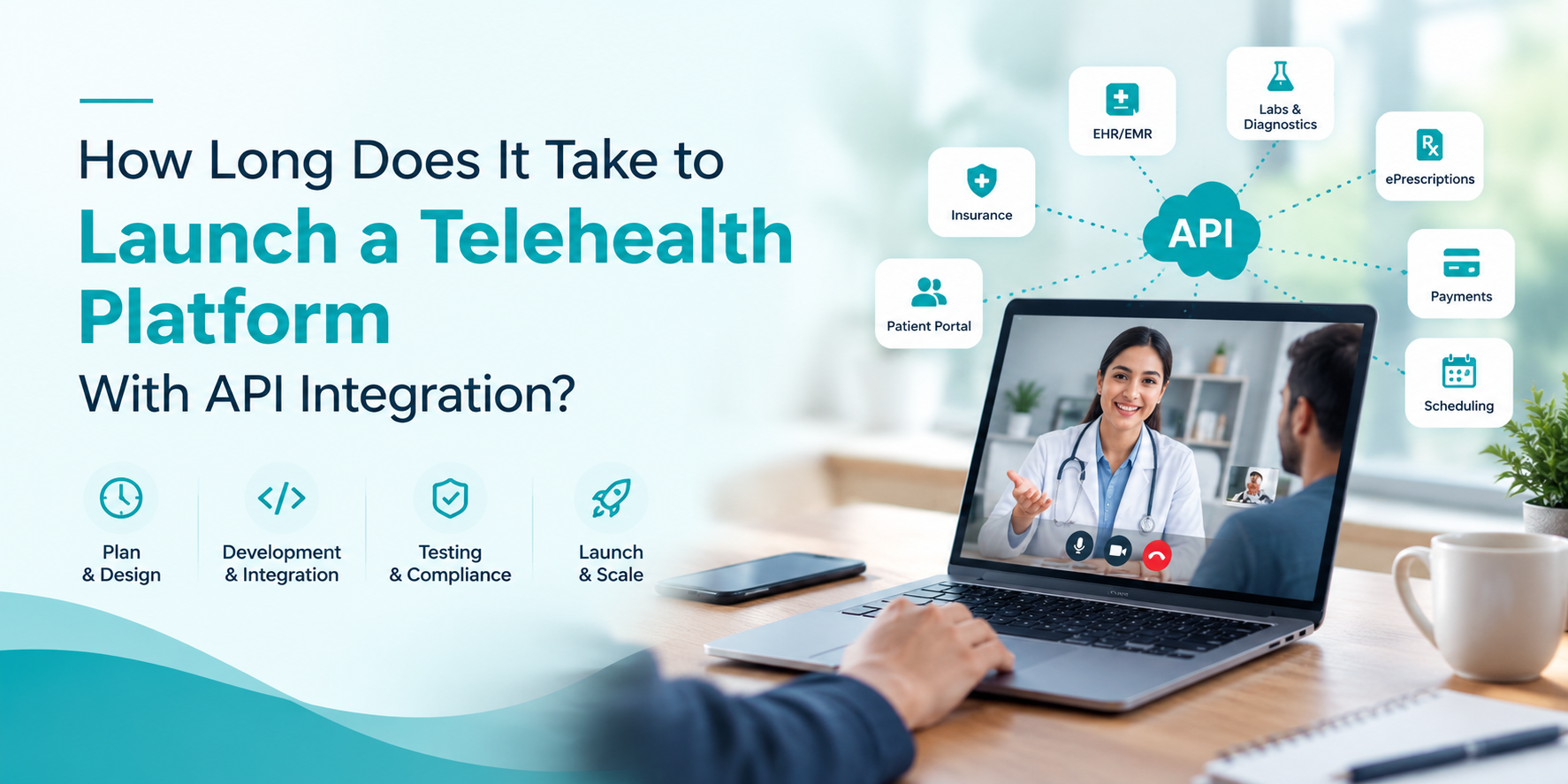
A telehealth platform may need to communicate with multiple third-party systems to deliver a connected patient experience.
Common healthcare API integrations include:
- Patient intake and onboarding APIs.
- Electronic Health Record (EHR) APIs.
- Telemedicine and video consultation APIs.
- Provider scheduling APIs.
- Electronic prescribing APIs.
- Pharmacy fulfillment APIs.
- Laboratory and diagnostic APIs.
- Payment processing APIs.
- Communication and notification APIs.
A well-planned telehealth platform API architecture allows different healthcare applications and services to exchange relevant information through supported endpoints.
The complexity depends on API documentation, authentication requirements, data mapping, vendor access, and the direction of data exchange.
Businesses should identify essential integrations during the initial planning stage to avoid unnecessary development and implementation delays.
3. Clinical and Operational Readiness
Technology alone cannot determine how quickly a healthcare platform becomes operational.
Healthcare businesses must also prepare provider workflows, clinical protocols, patient eligibility requirements, and operational processes.
Important considerations include:
- Provider availability and credentialing.
- Clinical workflow configuration.
- State-specific telehealth requirements.
- Prescription management processes.
- Pharmacy partner coordination.
- Laboratory service availability.
- Patient consent and documentation.
- Staff training and operational support.
Preparing these requirements alongside technical implementation can help create a smoother launch process.
Telehealth Platform Implementation Timeline: Step-by-Step
A structured implementation approach helps healthcare businesses understand what happens between selecting a platform and launching their digital healthcare services.
Phase 1: Discovery and Requirement Analysis (Week 1)
The first step is understanding the healthcare business model and defining the platform requirements.
During this phase, the implementation team identifies the intended patient journey, healthcare programs, integration requirements, and operational priorities.
Key activities include:
- Defining the telehealth business model.
- Identifying target patient segments.
- Mapping patient onboarding and consultation workflows.
- Selecting required third-party integrations.
- Identifying EHR, pharmacy, and laboratory requirements.
- Establishing technical and compliance requirements.
Expected outcome: A clear implementation roadmap covering platform configuration, API integration, and operational requirements.
Phase 2: Platform Configuration and White-Label Branding (Weeks 1–2)
Once the requirements are established, the platform can be configured around the healthcare business’s brand and operational model.
Key activities include:
- Website and application branding.
- Patient registration and onboarding configuration.
- Provider dashboard setup.
- Appointment scheduling configuration.
- Patient portal customization.
- Clinical workflow configuration.
- Administrative dashboard setup.
Healthcare businesses can explore white-label telehealth software to understand how branded digital healthcare experiences can operate on existing healthcare infrastructure.
Expected outcome: A configured telehealth environment aligned with the business’s branding and patient journey.
Phase 3: Telehealth API Integration and Healthcare System Connectivity (Weeks 2–4)
Telehealth API integration connects the platform with the external systems required to operate the healthcare business.
Depending on business requirements, this process may involve telemedicine API integration, EHR connectivity, pharmacy systems, laboratory services, and payment processing.
A structured telehealth software integration strategy allows businesses to coordinate multiple applications and establish connected patient workflows.
Key integration activities include:
- Connecting patient registration and intake APIs.
- Integrating provider scheduling workflows.
- Connecting EHR and clinical documentation systems.
- Configuring electronic prescribing.
- Integrating pharmacy fulfillment services.
- Connecting laboratory ordering and diagnostic results.
- Integrating payment and communication systems.
For example, when a patient completes an online health assessment, the relevant information can move into the appropriate clinical workflow for provider review.
Businesses planning custom integrations can review healthcare API integration capabilities to understand how different systems can connect within a digital healthcare environment.
Expected outcome: Connected healthcare systems that support the required patient and operational workflows.
Phase 4: Telehealth EHR Integration and Prescription Setup (Weeks 3–5)
Once the primary integrations are configured, healthcare businesses can validate the clinical workflows required for service delivery.
Telehealth EHR integration connects patient information, clinical documentation, provider workflows, and medication records across compatible healthcare systems.
Key activities include:
- Configuring provider workflows.
- Setting up clinical documentation.
- Connecting electronic prescribing.
- Establishing pharmacy routing workflows.
- Configuring laboratory ordering where required.
- Setting up patient follow-up processes.
- Validating clinical access permissions.
An integrated electronic prescription workflow can connect provider prescribing activities with supported pharmacy systems.
Similarly, electronic health record software helps coordinate clinical documentation, prescribing, laboratory services, and patient information within a connected record.
Expected outcome: A validated clinical workflow that supports the intended healthcare service model.
Phase 5: HIPAA Compliance, Security Validation, and Quality Assurance (Weeks 4–6)
Before launch, businesses should validate the complete patient journey and ensure that connected systems function as expected.
A HIPAA compliant healthcare API implementation requires appropriate safeguards for protected health information (PHI), including access controls, authentication, authorization, encryption where applicable, and secure data transmission.
Healthcare businesses should evaluate the security responsibilities of their platform, integration vendors, and connected systems.
Important testing activities include:
- API authentication and authorization testing.
- Patient registration and data synchronization.
- Appointment booking and scheduling.
- Video consultation functionality.
- EHR data exchange.
- Electronic prescription transmission.
- Pharmacy fulfillment workflows.
- Payment processing.
- Patient notifications.
- Role-based access controls.
- Security and performance testing.
Healthcare organizations should also evaluate applicable HIPAA requirements, data protection safeguards, business associate agreements, and security responsibilities across connected systems.
Expected outcome: A tested platform with validated integrations and operational workflows ready for controlled deployment.
Phase 6: Pilot Launch and Full Deployment (Weeks 6–8)
The final stage involves introducing the platform to an initial group of users and validating its performance in a live environment.
Key activities include:
- Initial patient onboarding.
- Provider and administrator training.
- Monitoring API performance.
- Reviewing patient journey completion.
- Tracking prescription and fulfillment workflows.
- Monitoring support requests.
- Collecting operational feedback.
- Preparing for wider deployment.
Expected outcome: A live telehealth platform with validated workflows and a foundation for future expansion.
Which API Integrations are Essential for Launching a Telehealth Platform?
A successful telehealth platform requires more than video consultation functionality. It should connect the systems involved in delivering and managing digital healthcare services.
1. Patient Intake API Integration
Patient intake APIs connect registration forms, health questionnaires, medical history, and consent information with the healthcare platform.
This supports digital patient registration, medical history collection, health assessment workflows, patient eligibility information, and consent management.
2. Telemedicine API Integration
Telemedicine API integration enables healthcare businesses to connect virtual consultation capabilities with their existing websites, applications, and patient portals.
Key capabilities include:
- Secure video consultations.
- Appointment scheduling.
- Virtual waiting rooms.
- Provider availability.
- Consultation access.
- Visit management.
This helps businesses incorporate virtual care into their existing patient-facing applications.
3. Telehealth EHR Integration
Electronic Health Record integration allows healthcare systems to exchange relevant patient and clinical information.
Depending on the supported integration, businesses may connect:
- Patient demographics.
- Medical histories.
- Clinical notes.
- Encounter information.
- Medication records.
- Laboratory results.
- Provider documentation.
Standards such as HL7 and FHIR can support structured healthcare data exchange, depending on the systems involved.
4. Telehealth Pharmacy API Integration
Telehealth pharmacy API integration connects clinical prescribing workflows with pharmacy systems to coordinate medication processing and fulfillment.
Depending on the integration, businesses can support:
- Electronic prescription transmission.
- Pharmacy selection and routing.
- Prescription status updates.
- Refill workflows.
- Fulfillment coordination.
- Patient notifications.
Connecting pharmacy fulfillment services with electronic prescribing can help healthcare brands coordinate the journey from provider review to medication fulfillment.
5. Laboratory and Diagnostic API Integration
Laboratory integration is important for healthcare programs that require diagnostic testing and provider review.
Depending on the laboratory partner and integration capabilities, the workflow may support:
- Laboratory test ordering.
- Diagnostic service coordination.
- Order status tracking.
- Laboratory result retrieval.
- Provider result review.
- Patient notifications.
A connected lab and diagnostics workflow can support healthcare businesses offering programs that involve ongoing testing and clinical monitoring.
6. Payment and Patient Engagement API Integration
Payment and engagement integrations support the business and patient experience beyond the initial consultation.
These integrations may include:
- Online payment processing.
- Recurring subscriptions.
- Membership management.
- Appointment reminders.
- Patient notifications.
- Follow-up communication.
- Ongoing patient engagement.
An integrated patient engagement platform can help businesses maintain communication throughout the patient journey.
How Can Healthcare Businesses Reduce Telehealth API Development and Implementation Time?
A well-planned implementation strategy can help businesses reduce unnecessary development and coordination.
1. Choose Existing Healthcare Infrastructure
Building every healthcare component independently can increase development requirements.
Using existing telehealth infrastructure with configurable modules can help businesses establish core workflows without creating every component from scratch.
2. Prioritize Essential API Integrations
Not every healthcare business requires the same integrations.
Start by identifying the systems essential to the first healthcare program. Additional integrations can be introduced as business requirements evolve.
3. Use a Phased Implementation Approach
Instead of launching every feature simultaneously, businesses can prioritize:
- Phase 1: Patient onboarding and virtual consultations.
- Phase 2: Provider workflows and clinical documentation.
- Phase 3: E-prescribing and pharmacy integration.
- Phase 4: Laboratory services and patient engagement.
- Phase 5: Advanced reporting and workflow automation.
4. Confirm API Readiness Early
Review API documentation, authentication requirements, sandbox availability, data structures, and vendor dependencies before beginning implementation.
Early technical validation can help identify potential integration issues before they affect the launch schedule.
5. Prepare Clinical and Operational Requirements in Parallel
Provider onboarding, clinical protocols, pharmacy coordination, and operational planning should progress alongside platform configuration.
6. Work With an Integrated Healthcare Infrastructure Partner
A healthcare infrastructure partner can help businesses coordinate multiple technology and operational requirements through a connected ecosystem.
Instead of managing separate vendors for telehealth software, providers, e-prescribing, pharmacy, and laboratories, businesses can evaluate telehealth platform integration solutions that bring these capabilities together.
How DrCare247 Helps Businesses Launch and Scale Telehealth Platforms
Launching a digital healthcare business involves coordinating technology, providers, prescriptions, pharmacy services, laboratories, and patient engagement.
DrCare247 provides a connected healthcare infrastructure platform designed to help healthcare startups, DTC brands, clinics, and digital health companies establish and scale their virtual care operations.
Rather than assembling every healthcare capability independently, businesses can leverage a connected ecosystem that brings software, clinical services, and healthcare integrations together.
1. White-Label Telehealth Platform
Businesses can establish a branded digital healthcare experience with configurable patient-facing workflows and platform capabilities.
This helps healthcare brands maintain their identity while leveraging existing healthcare technology infrastructure.
2. Healthcare API Integration
DrCare247 provides API and integration capabilities designed to connect digital healthcare workflows.
Businesses can evaluate integration opportunities across patient onboarding, clinical workflows, and supporting healthcare services based on their technical and operational requirements.
3. Physician Network
Healthcare businesses can access physician network capabilities or bring their own clinicians, depending on their operational requirements.
This provides flexibility when establishing provider workflows for different healthcare programs and markets.
4. Electronic Prescribing and Pharmacy Fulfillment
Connected prescribing and pharmacy capabilities help coordinate prescription workflows and medication fulfillment.
With supported e-prescribing and pharmacy connections, businesses can establish a more organized process between clinical review and pharmacy operations.
5. Lab and Diagnostics Integration
Businesses can incorporate laboratory services into their healthcare programs through connected lab ordering and results workflows, depending on their requirements.
6. Patient Engagement and AI-Powered Operations
DrCare247 also supports patient engagement and AI-powered healthcare operations to help coordinate administrative and clinical workflows.
By bringing these capabilities together, DrCare247 helps healthcare businesses establish a technology and operational foundation that can support their current launch requirements and future expansion.
Launch Your Telehealth Platform With Connected Healthcare Infrastructure
The time required to launch a telehealth platform depends on the technology approach, integration requirements, operational readiness, and complexity of the healthcare business.
While custom development can provide extensive flexibility, businesses looking to enter the digital healthcare market can benefit from leveraging existing infrastructure with supported API integrations.
The right implementation strategy should connect patient onboarding, telehealth consultations, provider networks, clinical documentation, electronic prescribing, pharmacy fulfillment, laboratory services, and patient engagement into one coordinated ecosystem.
Whether you are launching a new virtual care business, expanding an existing healthcare service, or integrating telehealth capabilities into your current platform, DrCare247 can help you evaluate an implementation approach aligned with your business requirements.
Planning to launch a telehealth platform? Connect with DrCare247 to discuss your API integration requirements, white-label telehealth infrastructure, implementation timeline, and scalable healthcare technology needs.
FAQs
Launching a telehealth platform using existing infrastructure may take approximately 2–8 weeks, depending on customization, API integration requirements, and operational readiness. Custom-built platforms may take 3–6 months or longer.
A telehealth platform typically requires patient intake APIs, EHR APIs, video consultation APIs, provider scheduling APIs, e-prescribing APIs, pharmacy APIs, laboratory APIs, payment APIs, and patient engagement integrations.
Telehealth API integration connects broader healthcare services, including patient management, EHR systems, pharmacy fulfillment, and laboratory workflows. Telemedicine API integration primarily focuses on virtual consultations, appointment scheduling, and remote clinical interactions.
Yes. A telehealth platform can integrate with compatible EHR and pharmacy systems through supported APIs and healthcare data exchange standards such as HL7 and FHIR. Integration capabilities depend on vendor support and available API endpoints.
DrCare247 provides connected healthcare infrastructure, including white-label telehealth technology, healthcare API integrations, physician network capabilities, electronic prescribing, pharmacy fulfillment, laboratory services, and patient engagement to help healthcare startups, DTC brands, and digital health businesses launch and scale virtual care services.