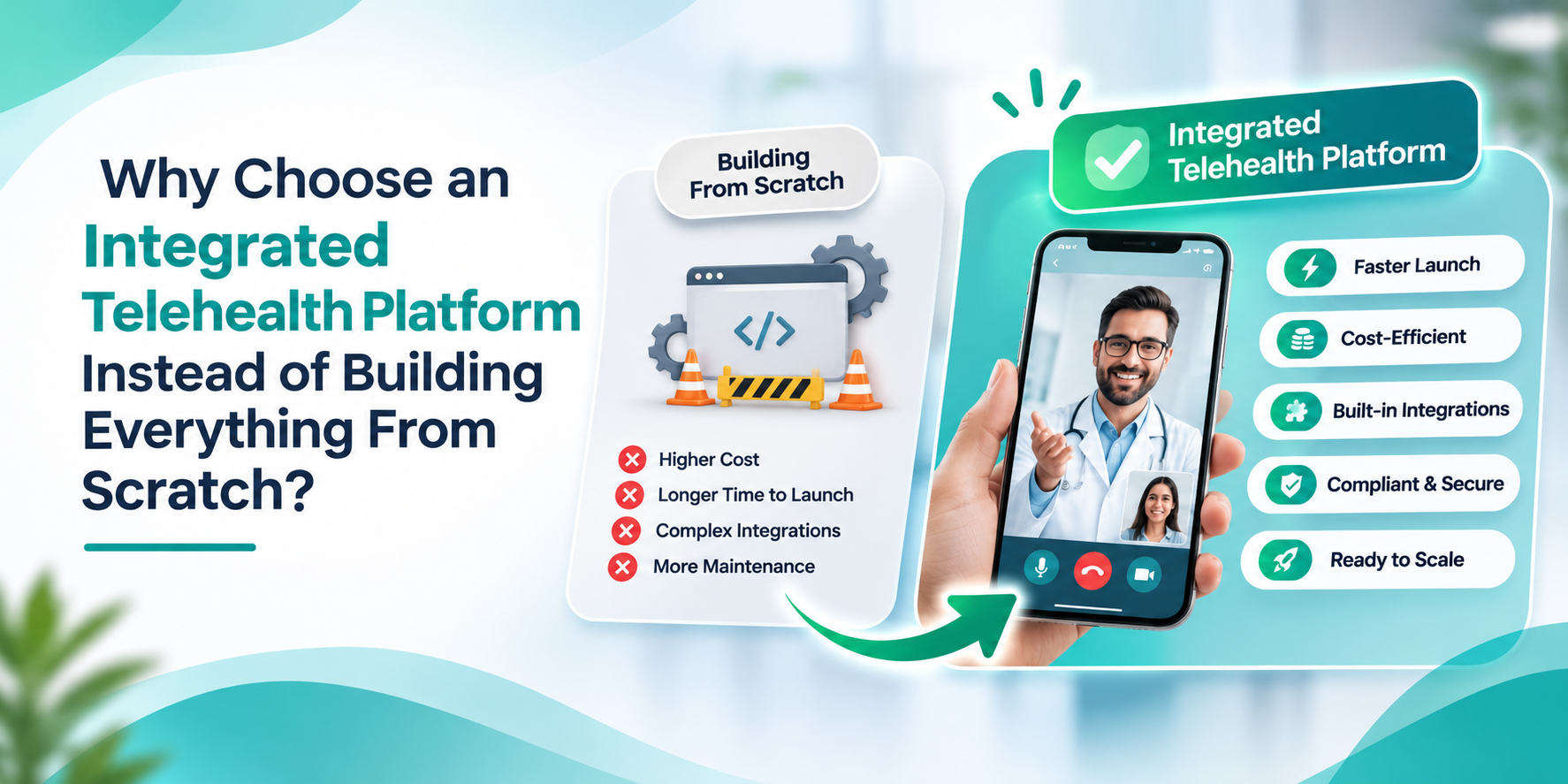
Healthcare businesses looking to launch or expand digital healthcare services often face an important technology decision: should they build their own healthcare infrastructure or adopt an existing integrated telehealth platform?
Building a digital healthcare ecosystem from scratch may appear attractive because it offers greater control over technology, workflows, and customization. However, developing individual systems for patient onboarding, virtual consultations, provider management, electronic health records, e-prescribing, pharmacy fulfillment, and laboratory integrations requires significant development resources and ongoing operational support.
For healthcare startups, clinics, hospitals, and digital health enterprises, these requirements can increase implementation complexity and delay market entry.
An integrated telehealth platform offers an alternative by connecting essential healthcare capabilities through an existing technology infrastructure. Instead of independently developing every component, businesses can leverage available software, integrations, and healthcare service capabilities to establish connected digital healthcare operations.
For organizations prioritizing faster implementation, operational efficiency, and long-term scalability, choosing the right telehealth infrastructure can become an important business advantage.
Core Capabilities of an Integrated Telehealth Platform
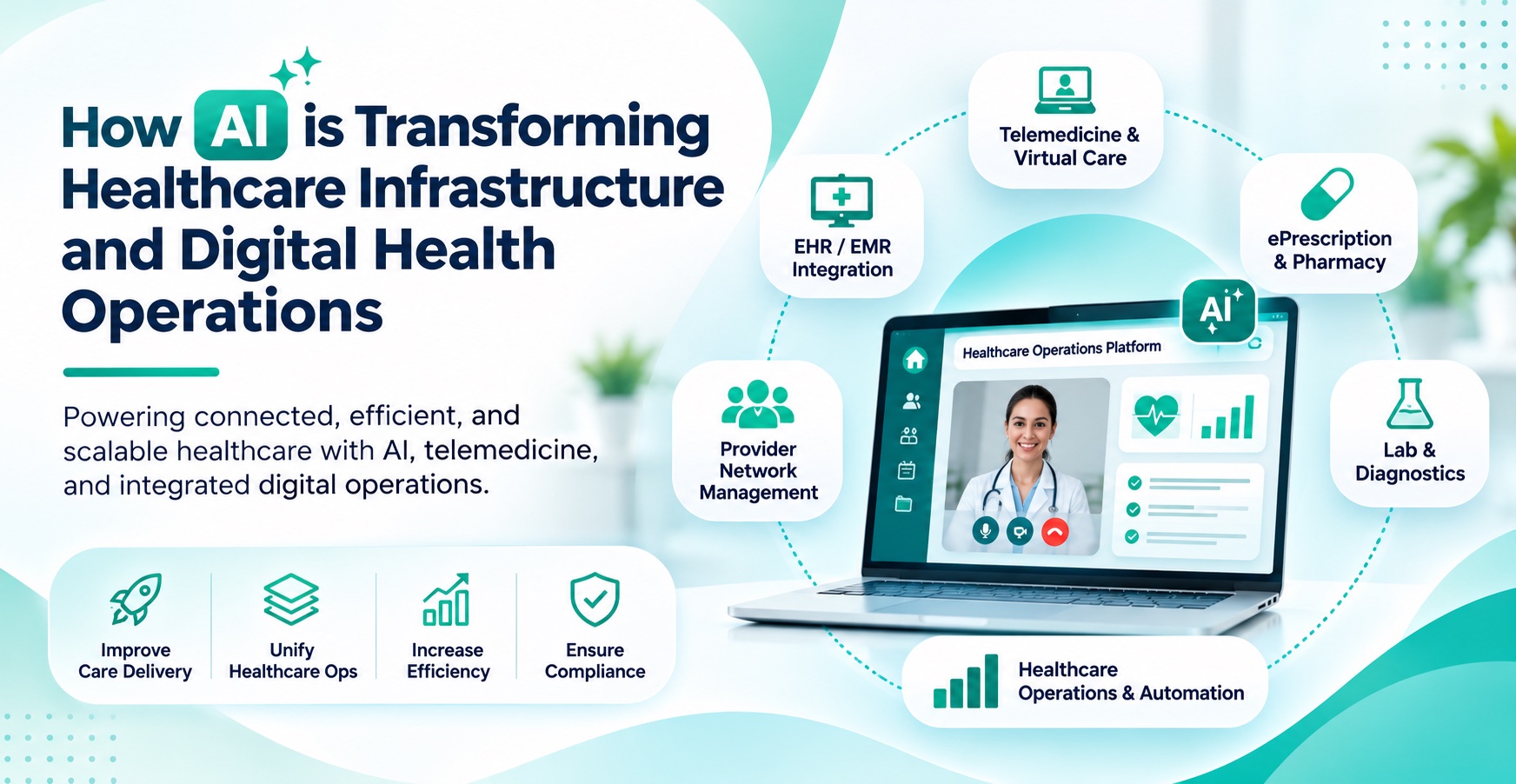
An integrated telehealth platform is a connected technology solution that brings multiple healthcare capabilities together within a unified infrastructure.
Unlike standalone telehealth software that primarily focuses on virtual consultations, integrated telehealth software can support different stages of healthcare delivery, including:
- Patient onboarding and digital intake.
- Appointment scheduling and management.
- Virtual consultations and telemedicine workflows.
- Electronic health records (EHR) and clinical documentation.
- Electronic prescribing and prescription management.
- Pharmacy connectivity and fulfillment coordination.
- Laboratory and diagnostic service integrations.
- Payment processing and patient engagement.
An all-in-one telehealth platform helps businesses connect these capabilities without independently developing every technology component.
For healthcare organizations, this approach can simplify vendor coordination, support connected patient experiences, and create a foundation for expanding digital healthcare services.
Why are Healthcare Businesses Moving Toward Integrated Telehealth Platforms?
Healthcare delivery involves several interconnected systems, service providers, and operational processes. Managing these components independently can create technical and administrative challenges.
For example, a healthcare startup launching a virtual care service may need separate vendors for consultation software, physician networks, EHR systems, pharmacy connectivity, and payment processing.
Coordinating these providers requires additional integration work, technical resources, and operational management.
An integrated telemedicine platform can help address these challenges by bringing essential capabilities together through existing infrastructure and supported integrations.
Here are the key reasons healthcare businesses consider this approach.
- Faster Time to Market Without Extensive Development
Building a telehealth solution from scratch involves multiple development stages, including requirement analysis, architecture planning, software development, integration, testing, and deployment.
Each component requires technical resources and coordination before the complete healthcare ecosystem becomes operational.
An end-to-end telehealth platform provides access to existing technology capabilities, helping businesses reduce the amount of infrastructure they need to develop independently.
For healthcare startups and digital health entrepreneurs, this can help accelerate implementation and allow internal teams to concentrate on business development, patient acquisition, and service positioning.
Rather than spending months coordinating individual technology components, businesses can evaluate an existing platform and configure the capabilities required for their healthcare model.
- Reduce Infrastructure Development and Operational Complexity
Developing individual healthcare applications requires investment in engineering teams, hosting infrastructure, software maintenance, integration management, and technical support.
These responsibilities can increase the overall cost of launching and maintaining digital healthcare services.
An integrated telehealth software solution can reduce the need to manage multiple independently developed systems.
However, businesses should evaluate the complete commercial model, including implementation charges, licensing, usage-based fees, integration costs, and ongoing support.
The objective is not simply to reduce software expenses but to understand the total cost of operating a connected healthcare ecosystem.
- White-Label Branding and Business Customization
Healthcare businesses often want to establish their own brand identity rather than directing patients to third-party applications.
A white-label telehealth platform allows businesses to leverage existing infrastructure while customizing available patient-facing experiences.
Depending on the platform’s capabilities, branding options may include:
- Business logos and brand elements.
- Customized patient portals.
- Branded consultation experiences.
- Customized patient onboarding workflows.
- Service-specific healthcare programs.
- Patient communication and engagement experiences.
This approach is particularly relevant for healthcare startups, digital health companies, and enterprises launching direct-to-consumer healthcare services.
Businesses can concentrate on building their market identity while leveraging an existing technology foundation.
- Simplified EHR and Healthcare API Integrations
Healthcare businesses frequently need to connect multiple applications to support clinical and administrative workflows.
A telehealth platform with EHR integration can help connect virtual care activities with electronic health records and clinical documentation systems.
Similarly, healthcare APIs can support connectivity with:
- Electronic health record systems.
- Pharmacy management applications.
- Laboratory information systems.
- Payment gateways.
- Patient engagement applications.
- Third-party healthcare services.
With custom development, each integration may require separate technical planning, development, testing, and maintenance.
An integrated platform with supported APIs can simplify this process by providing established integration options.
Before implementation, businesses should verify API documentation, data exchange capabilities, integration limitations, and compatibility with their existing systems.
- Connected Physician Network and Clinical Workflows
Launching virtual healthcare services requires more than consultation software. Businesses may also need qualified healthcare professionals, clinical workflows, provider scheduling, and appropriate operational arrangements.
A telehealth platform for healthcare providers may offer access to physician networks or provider infrastructure, depending on the platform’s service model.
This can help healthcare businesses coordinate consultation workflows without independently establishing every provider-related arrangement.
For organizations entering new healthcare markets, evaluating provider availability, licensing requirements, clinical responsibilities, and coverage is particularly important.
- Pharmacy Integration and Prescription Fulfillment
Prescription management is another important component of digital healthcare operations.
A telehealth platform with pharmacy integration can help connect clinical consultations with electronic prescribing and pharmacy fulfillment workflows.
A connected prescription workflow may include:
1. Patient onboarding and clinical intake.
2. Provider consultation and assessment.
3. Prescription creation based on clinical decisions.
4. Electronic prescription transmission.
5. Pharmacy processing and fulfillment.
6. Fulfillment updates and patient communication.
For healthcare startups offering services such as men’s health, weight management, dermatology, and other clinical programs, connected pharmacy workflows can support more coordinated operations.
Businesses should evaluate pharmacy network availability, prescription compatibility, fulfillment timelines, geographic coverage, and integration responsibilities before selecting a platform.
- Connected Laboratory and Diagnostic Services
Laboratory testing and diagnostic services can play an important role in virtual healthcare programs.
For example, weight management, hormone therapy, preventive health, and chronic care programs may require laboratory testing as part of clinical evaluation and ongoing monitoring.
An integrated telehealth platform may support laboratory connectivity through available integrations and service partnerships.
This can help businesses coordinate different stages of care, including laboratory orders, diagnostic workflows, result availability, and provider review.
Instead of managing disconnected technology systems, healthcare businesses can explore connected laboratory capabilities within their broader telehealth infrastructure.
- Better Patient Management and Connected Experiences
A successful digital healthcare business needs consistent workflows throughout the patient journey.
A telehealth platform with patient management capabilities can support patient onboarding, appointment scheduling, consultation coordination, clinical documentation, and patient engagement.
When these processes operate through connected systems, businesses can reduce unnecessary administrative handoffs and improve workflow visibility.
For healthcare organizations, this also creates opportunities to develop more consistent patient experiences across different digital healthcare services.
- Scalability for Growing Healthcare Businesses
Healthcare businesses may begin with one clinical service and gradually expand into additional healthcare programs, locations, or patient segments.
For example, a digital health startup may initially launch virtual consultations before introducing additional programs such as weight management, hormone health, dermatology, and preventive care.
An enterprise telehealth platform should provide the flexibility to support additional workflows, integrations, and operational requirements as the business grows.
Leveraging available infrastructure can reduce the need to rebuild core systems every time a business introduces a new service.
However, scalability should be evaluated based on actual platform capacity, integration limitations, service availability, and commercial terms.
Custom Telehealth Development vs. Integrated Telehealth Platform
Both approaches offer advantages, but their suitability depends on business objectives, available technical resources, and operational requirements.
|
Evaluation Factor |
Custom Development |
Integrated Telehealth Platform |
|
Initial Development |
Requires building core systems |
Uses existing platform capabilities |
|
Branding |
Fully customizable |
Supports available white-label options |
|
API Integration |
Requires custom development |
Uses supported APIs and integrations |
|
Provider Infrastructure |
Requires separate arrangements |
May provide access to provider networks |
|
Pharmacy Connectivity |
Requires partner coordination |
May include existing pharmacy connections |
|
Laboratory Services |
Requires separate integrations |
May include connected lab capabilities |
|
Patient Management |
Requires individual system development |
May include connected patient workflows |
|
Maintenance |
Managed internally or through vendors |
Depends on platform responsibilities |
|
Implementation |
Depends on development complexity |
Can leverage existing infrastructure |
|
Expansion |
Requires additional development |
Can leverage available infrastructure |
How to Choose the Right Integrated Telemedicine Platform for Your Business
Choosing a platform requires more than comparing software features. Healthcare businesses should evaluate how well the infrastructure supports their business model, clinical operations, and long-term expansion plans.
Consider these important factors before selecting a technology partner.
- Evaluate Healthcare Infrastructure Capabilities
Determine whether the platform supports your essential requirements, including teleconsultation, patient onboarding, EHR connectivity, e-prescribing, pharmacy integration, and laboratory services.
- Review Security and HIPAA Requirements
For businesses operating in the United States, evaluate the platform’s security safeguards, access controls, encryption practices, audit capabilities, and applicable contractual obligations, including Business Associate Agreements (BAAs).
HIPAA compliance responsibilities depend on the organization’s role and how protected health information is handled.
- Assess Integration Flexibility
Review available APIs, integration documentation, third-party compatibility, and customization options.
The platform should support the integrations required for your existing and planned healthcare operations.
- Understand the Commercial Model
Compare subscription fees, implementation costs, per-encounter charges, prescription-related fees, integration expenses, and ongoing maintenance costs.
A transparent commercial structure helps businesses estimate their total operating costs.
- Check Implementation and Technical Support
Understand the onboarding process, implementation timeline, technical assistance, integration support, and ongoing maintenance responsibilities.
Ask the provider which capabilities are available immediately and which require additional development or third-party arrangements.
- Consider Long-Term Business Expansion
Evaluate whether the platform can support additional clinical programs, higher patient volumes, new integrations, and expansion into additional markets.
Selecting infrastructure that aligns with future business requirements can reduce technology migration and redevelopment challenges.
When Should Healthcare Businesses Choose an Integrated Telehealth Platform?
An integrated platform can be particularly suitable for businesses that want to:
- Launch a new telehealth startup without building an entire technology stack.
- Expand an existing clinic or hospital into virtual care.
- Develop a white-label digital healthcare business.
- Introduce subscription-based healthcare programs.
- Connect physician networks, pharmacies, and laboratories.
- Expand existing telemedicine operations into additional clinical services.
- Reduce the complexity of managing multiple technology vendors.
Custom development may still be appropriate when an organization requires highly specialized workflows, proprietary technology, or complete control over its software architecture.
The decision should ultimately depend on the balance between customization, implementation speed, operational resources, and long-term business objectives.
Build and Scale Digital Healthcare Services with DrCare247
Launching a digital healthcare business requires more than selecting telemedicine software. It requires an infrastructure that can support technology, clinical workflows, healthcare integrations, and operational expansion.
DrCare247 provides integrated healthcare infrastructure designed to help businesses launch and expand digital healthcare services.
Its platform capabilities include:
Telemedicine Software: Support virtual consultations and connected digital care workflows.
1. Physician Networks: Explore provider infrastructure to support healthcare service delivery.
2. Pharmacy Fulfillment: Connect prescription workflows with available pharmacy fulfillment capabilities.
3. Laboratory Services: Support connected laboratory and diagnostic service workflows.
4. Payment Processing: Integrate payment capabilities into digital healthcare operations.
5. AI-Powered Healthcare Operations: Explore AI capabilities that support healthcare workflows and operational efficiency.
6. White-Label Capabilities: Build branded digital healthcare experiences using available customization options.
Whether you are launching a healthcare startup, expanding an existing clinic, or developing a direct-to-consumer healthcare business, DrCare247 offers infrastructure capabilities to help support your digital healthcare strategy.
Instead of independently coordinating every technology component, businesses can explore a connected approach to launching, operating, and expanding healthcare services.
Ready to build your digital healthcare business?
Explore DrCare247’s integrated telehealth infrastructure and discover how connected healthcare capabilities can support your business objectives.
FAQs
Clinics can leverage existing telehealth infrastructure, configure available branding options, connect required healthcare applications, establish clinical workflows, and onboard healthcare providers. This can reduce the need to develop individual systems independently.
An integrated telemedicine platform should support virtual consultations, patient onboarding, appointment scheduling, EHR connectivity, clinical documentation, electronic prescribing, pharmacy integration, patient management, and secure healthcare workflows.
Evaluate the platform’s implementation timeline, white-label capabilities, integration options, provider infrastructure, pharmacy connectivity, pricing structure, security safeguards, and scalability. Select a solution that supports both your initial launch requirements and long-term business objectives.
Healthcare businesses should look for platforms that connect digital patient intake, clinical assessments, electronic prescribing, and pharmacy fulfillment workflows. Before selecting a provider, verify which capabilities are native, which rely on third-party integrations, and which require separate partnerships.
DrCare247 provides connected healthcare infrastructure, including white-label telehealth technology, healthcare API integrations, physician network capabilities, electronic prescribing, pharmacy fulfillment, laboratory services, and patient engagement to help healthcare startups, DTC brands, and digital health businesses launch and scale virtual care services.