Introduction
The growing adoption of virtual healthcare has created new opportunities for telehealth companies, digital health startups, healthcare providers, and healthcare enterprises to expand prescription-based services.
As businesses introduce clinical programs such as men’s health, women’s health, weight management, dermatology, hormone therapy, and preventive healthcare, having a reliable pharmacy fulfillment partner becomes an important part of their operational infrastructure.
However, building a successful telehealth business requires more than providing virtual consultations. Businesses need connected technology systems that support patient onboarding, provider consultations, electronic prescribing, pharmacy communication, medication fulfillment, and patient engagement.
A reliable pharmacy fulfillment partner helps telehealth companies coordinate prescription processing and medication delivery while supporting their broader healthcare operations.
For organizations planning to launch or scale a virtual healthcare platform, choosing the right pharmacy partner involves evaluating medication availability, pharmacy API integration, prescription management, fulfillment capabilities, technology compatibility, and operational scalability.
In this guide, we explore seven important factors businesses should consider when selecting a pharmacy fulfillment partner and how an integrated telehealth platform can simplify pharmacy and prescription workflows.
Pharmacy Fulfillment in Telehealth
Pharmacy fulfillment in telehealth refers to the process of receiving, processing, dispensing, packaging, and delivering medications prescribed through a virtual healthcare platform.
It connects the clinical workflow with pharmacy operations, allowing prescriptions generated during provider consultations to move through the appropriate fulfillment process.
A typical telehealth pharmacy fulfillment workflow includes:
- Patient Registration: Patients register through a digital healthcare platform and complete digital intake forms.
- Clinical Assessment: Healthcare providers review patient information and evaluate treatment requirements.
- Prescription Generation: Providers generate appropriate prescriptions based on their clinical decisions.
- E-Prescribing: Prescription information is transmitted electronically through supported prescribing systems.
- Pharmacy Processing: The pharmacy receives and processes prescription requests.
- Medication Fulfillment: Approved prescriptions proceed through dispensing, packaging, and shipping.
- Patient Communication: Patients receive relevant prescription and delivery updates.
For telehealth companies, an organized pharmacy fulfillment workflow helps connect healthcare technology, clinical operations, and medication management.
Why is Pharmacy Fulfillment Important for Telehealth Businesses?
Pharmacy fulfillment is an important operational component for businesses offering prescription-based virtual healthcare services.
When prescription management and pharmacy operations are disconnected, healthcare teams may need to coordinate information across multiple platforms, increasing administrative work and limiting visibility into prescription progress.
Integrating pharmacy workflows with telehealth software can help businesses establish more organized operations.
Key business benefits include:
Connected workflows help coordinate prescription information between healthcare providers, telehealth systems, and pharmacy partners. This can support a more structured approach to prescription processing and medication management.
2. Improved Operational Efficiency
Pharmacy API integration can reduce repetitive manual communication and simplify prescription-related administrative activities, allowing operational teams to manage workflows more effectively.
3. Better Fulfillment Visibility
Supported prescription status updates and delivery notifications help businesses monitor fulfillment progress and identify issues that require attention.
4. Enhanced Patient Experience
Organized prescription processing and timely communication contribute to a more coordinated patient journey, from virtual consultation to medication delivery.
5. Business Scalability
A suitable pharmacy partner can support growing prescription volumes, additional clinical programs, and broader geographic coverage as a telehealth business expands.
What Should Telehealth Brands Evaluate Before Choosing a Pharmacy Fulfillment Partner?
Selecting a pharmacy partner is a strategic decision for any telehealth company offering prescription-based care.
A pharmacy integration partner should support the clinical, operational, and technical requirements of the business.
Here are seven important factors to evaluate.
1. Pharmacy Licensing and Regulatory Compliance
Pharmacy licensing and regulatory compliance should be among the first considerations when evaluating a pharmacy fulfillment partner.
Telehealth companies operating in the United States should verify that their pharmacy partners have the applicable state licenses and dispensing permissions required to serve their intended patient population.
For businesses planning to operate across multiple states, geographic licensing coverage is particularly important.
Evaluate the following:
- Applicable state pharmacy licenses.
- Geographic dispensing coverage.
- Regulatory standing and relevant inspection history.
- Prescription verification procedures.
- Medication dispensing processes.
- Patient privacy and data protection practices.
- Documentation and recordkeeping procedures.
Businesses should also understand the responsibilities of the telehealth provider, prescribing organization, and pharmacy partner within the overall prescription workflow.
Evaluating these requirements before implementation helps businesses establish a more reliable operational foundation.
2. Medication Availability
Medication availability is another important consideration when selecting a pharmacy fulfillment partner.
Different telehealth companies operate different clinical programs, and their medication requirements vary depending on their services and patient populations.
For example, a digital health company offering men’s health services may have different medication requirements compared with a platform specializing in dermatology, women’s health, or weight management.
Evaluate whether the pharmacy can reliably dispense the commercially available generic medications and other prescribed products required by your clinical programs.
Consider the following:
- Availability of commonly prescribed generic medications.
- Supported medication strengths and formulations.
- Availability of different dosage forms.
- Medication inventory management.
- Medication sourcing procedures.
- Processes for handling medication shortages.
- Ability to support additional medication categories.
Aligning Medication Availability With Clinical Programs
Businesses should evaluate pharmacy capabilities according to their treatment categories.
|
Clinical program |
Medication requirements to evaluate |
|
Men’s Health |
Availability of medications prescribed for appropriate men’s health services |
|
Women’s Health |
Support for medications associated with eligible women’s health programs |
|
Weight Management |
Availability of medications prescribed under applicable clinical requirements |
|
Dermatology |
Access to prescribed topical and oral dermatological medications |
|
Hormone Therapy |
Appropriate medication availability and fulfillment processes |
|
Preventive Healthcare |
Medication support aligned with relevant clinical services |
A detailed medication availability assessment helps telehealth businesses identify partners that can support their current services and future expansion plans.
3. Pharmacy API Integration
A pharmacy API integration connects telehealth software with pharmacy systems to support prescription transmission and relevant fulfillment information.
For healthcare technology companies, API connectivity is essential for establishing communication between clinical applications, electronic prescribing systems, and pharmacy operations.
Instead of relying entirely on manual coordination, businesses can use integrated workflows to exchange prescription information and fulfillment updates between connected systems.
Evaluate whether the pharmacy API integration supports:
- Prescription submission.
- Prescription status updates.
- Pharmacy communication.
- Refill requests.
- Fulfillment notifications.
- Prescription cancellation workflows, where supported.
- Error handling and transmission notifications.
- Secure data exchange.
- Integration documentation.
- Technical support and maintenance.
How Pharmacy API Integration Supports Business Operations
Consider a telehealth platform offering online consultations and prescription-based services.
After a consultation, an authorized healthcare provider generates a prescription through the supported e-prescribing workflow.
The prescription information is transmitted to the designated pharmacy through the available integration.
The pharmacy processes the prescription and provides relevant status information through supported communication channels.
This connected workflow helps businesses improve prescription visibility and coordinate operations between their technology platform and pharmacy partners.
Before selecting an integration partner, evaluate API documentation, authentication, data security, testing environments, system availability, and ongoing technical support. Effective healthcare system integrations can help telehealth businesses connect third-party applications, streamline information exchange, and establish more coordinated operational workflows.
Prescription Fulfillment and Delivery
Prescription fulfillment and delivery are important components of the overall virtual healthcare experience.
After a provider generates a prescription, the pharmacy manages the applicable verification, dispensing, packaging, and shipping processes.
Telehealth businesses should understand how these activities are managed and what information is available to their internal teams.
Evaluate the following:
1. Prescription Processing
Understand how the pharmacy receives prescriptions, reviews prescription information, and handles clarification requests.
2.Medication Dispensing
Review the pharmacy’s dispensing procedures and processes for managing prescription exceptions.
3. Packaging and Shipping
Evaluate medication packaging, shipping procedures, and the availability of appropriate delivery options.
5. Fulfillment Tracking
Check whether the pharmacy provides prescription status updates, shipment tracking, and delivery notifications through supported systems.
6. Service-Level Expectations
Understand the partner’s operational timelines, fulfillment capacity, and escalation procedures.
7. Geographic Coverage
Confirm which states and patient locations the pharmacy can serve.
A clearly defined fulfillment workflow helps telehealth businesses establish operational expectations and coordinate prescription-related activities more effectively.
8. Medication Quality and Safety Processes
Medication quality and safety are important considerations for every healthcare business offering prescription-based services.
Telehealth companies should evaluate the pharmacy’s quality management procedures, medication handling practices, dispensing accuracy, and patient complaint management processes.
Important areas to review include:
- Medication sourcing and supplier qualification.
- Storage and handling procedures.
- Temperature-controlled shipping, where required.
- Inventory and expiration date management.
- Prescription verification procedures.
- Medication recall management.
- Patient complaints and adverse event communication.
- Quality assurance processes.
- Documentation and recordkeeping.
9. Building Reliable Pharmacy Operations
Businesses should understand how the pharmacy manages medication-related issues and communicates important information to healthcare providers and patients.
For example, when a medication becomes unavailable or a prescription requires clarification, the pharmacy should have a defined communication and escalation process.
Establishing clear operational responsibilities between telehealth businesses and pharmacy partners helps support more organized medication management.
10 .Integration With Your Telehealth Platform
Your pharmacy partner should fit into the broader technology infrastructure of your healthcare business.
Pharmacy fulfillment should not operate as an isolated activity. It should connect with the other processes involved in delivering virtual healthcare services.
An integrated telehealth platform can help coordinate patient registration, clinical intake, provider consultations, electronic prescribing, pharmacy fulfillment, and patient engagement.
The ideal workflow should connect:
- Patient registration.
- Digital clinical intake.
- Provider consultations.
- Electronic health records.
- E-prescribing.
- Pharmacy fulfillment.
- Patient notifications.
- Prescription management.
- Follow-up communication.
- Reporting and analytics.
11. Building a Connected Digital Healthcare Workflow
Consider a healthcare startup launching a branded virtual healthcare platform.
Patients register through the company’s website and complete digital intake forms. Healthcare providers review patient information and conduct virtual consultations.
When clinically appropriate, providers generate prescriptions through supported electronic prescribing workflows.
Prescription information is transmitted to the designated pharmacy partner, where it moves through the applicable processing and fulfillment stages.
Relevant prescription and fulfillment updates can then be made available through connected systems.
This approach helps businesses coordinate clinical and operational workflows without relying entirely on separate systems.
Why White-Label Telehealth Software Matters
White-label telehealth software enables businesses to establish their own branded digital healthcare experience using an underlying technology platform.
Rather than developing every operational component independently, healthcare startups and enterprises can use a unified infrastructure to support patient onboarding, consultations, prescription workflows, integrations, and patient engagement.
A scalable white-label telehealth software solution can help healthcare businesses establish branded virtual care services while connecting essential digital healthcare workflows.
1. Scalability and Commercial Model
As prescription volumes grow, pharmacy operations must support increased demand without creating unnecessary manual work.
A pharmacy partner that meets the initial requirements of a startup may not necessarily support the operational needs of an expanding telehealth business.
Businesses should evaluate the commercial structure, technical capabilities, geographic coverage, and long-term operational capacity before selecting a partner.
2. Evaluate the Commercial Model
Understand the complete cost structure before entering into a partnership.
Consider:
- Initial onboarding and setup fees.
- API integration and development costs.
- Monthly platform or service charges.
- Prescription dispensing charges.
- Medication costs.
- Packaging and shipping expenses.
- Refill processing costs.
- Additional operational fees.
- Contract terms and minimum volume commitments.
3. Evaluate Operational Scalability
Beyond pricing, assess whether the pharmacy can support business expansion.
Important considerations include:
- Ability to manage increased prescription volumes.
- Geographic and state coverage.
- Medication availability as demand increases.
- Integration capacity.
- Technical and operational support.
- Fulfillment performance monitoring.
- Ability to accommodate additional clinical programs.
4. Supporting Long-Term Healthcare Business Growth
A telehealth company may initially launch with one clinical program and gradually expand into men’s health, dermatology, weight management, hormone therapy, and other virtual healthcare services.
Its pharmacy fulfillment strategy should be flexible enough to support additional operational requirements as the business grows.
Choosing a pharmacy partner based on technical compatibility, operational reliability, and commercial transparency helps businesses establish a sustainable fulfillment strategy.
How an Integrated Telehealth Platform Simplifies Prescription and Pharmacy Workflows
Managing prescriptions through disconnected systems can create operational challenges for healthcare businesses.
Separate systems for patient intake, provider consultations, e-prescribing, pharmacy communication, and follow-up care can increase administrative workload and make it difficult to monitor the patient journey.
An integrated telehealth platform can help connect these processes through a unified digital healthcare workflow.
For healthcare startups, digital health companies, and established healthcare providers, this connected infrastructure can support more organized prescription management and operational coordination.
Understanding the Connected Telehealth and Pharmacy Workflow
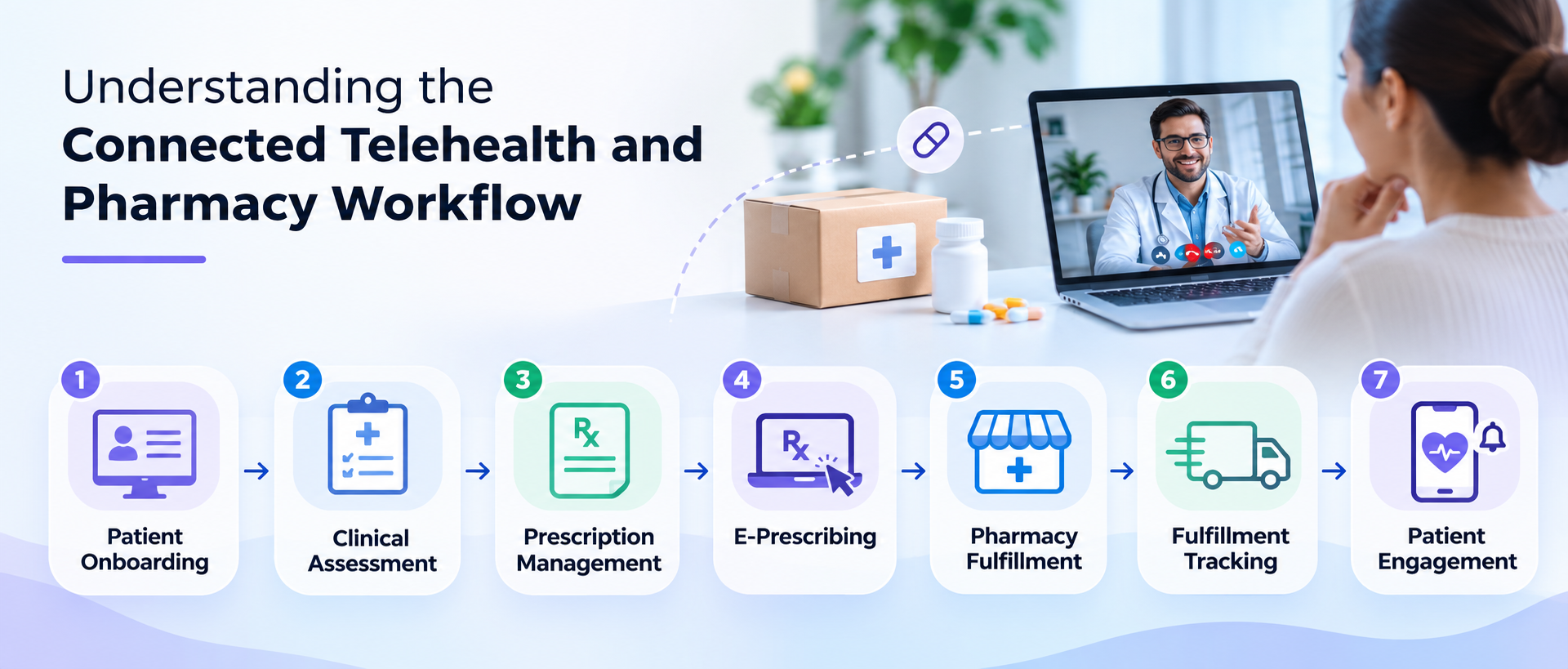
A connected telehealth infrastructure can support the fllowing patient journey:
- Patient Onboarding
- Patient Onboarding
Patients register through the healthcare platform and complete digital intake forms.
The system collects relevant patient information to support the clinical workflow.
- Clinical Assessment
Healthcare providers review patient information, evaluate medical history, and assess treatment requirements.
- Prescription Management
When clinically appropriate, providers generate prescriptions based on their clinical decisions.
- E-Prescribing
Prescription information is transmitted through supported electronic prescribing workflows, connecting clinical systems with pharmacy operations. Effective electronic prescription management helps establish a structured process for transmitting prescriptions and coordinating medication-related activities.
- Pharmacy Fulfillment
Prescriptions are routed to the appropriate pharmacy partner for processing, dispensing, packaging, and shipping.
- Fulfillment Tracking
Relevant prescription and order status updates can be made available through supported integration workflows.
- Patient Engagement
Patients receive relevant notifications and follow-up communication throughout their healthcare journey. Connected patient engagement solutions can help healthcare businesses coordinate communication, improve patient interactions, and support continuity across different stages of virtual care.
This integrated approach can help healthcare businesses reduce manual coordination, improve prescription visibility, and establish more organized medication management processes.
Building Scalable Telehealth Infrastructure for Prescription-Based Healthcare
Launching and scaling a virtual healthcare business requires technology that supports more than online consultations.
Healthcare organizations need an integrated telehealth infrastructure that connects patient onboarding, provider workflows, prescription management, pharmacy integrations, and patient engagement.
A scalable telehealth platform can help businesses coordinate clinical and operational activities through connected digital workflows.
For telehealth startups, healthcare providers, and digital health enterprises, selecting technology that supports healthcare integrations, electronic prescribing, virtual consultations, and patient engagement is an important step toward building a sustainable virtual care business.
Pharmacy Fulfillment Partner Evaluation Checklist for Telehealth Businesses
Before finalizing a pharmacy partnership, businesses should conduct a structured evaluation of the pharmacy’s operational, technical, and commercial capabilities.
|
Evaluation area |
What to verify |
|
Licensing and compliance |
Applicable state licenses and dispensing permissions |
|
Medication availability |
Supported medications, strengths, and formulations |
|
API integration |
Prescription transmission and status updates |
|
Fulfillment capabilities |
Dispensing, packaging, shipping, and tracking |
|
Medication quality |
Storage, handling, and quality assurance |
|
Platform compatibility |
Integration with telehealth and e-prescribing systems |
|
Geographic coverage |
Supported states and patient locations |
|
Commercial model |
Integration, dispensing, and shipping costs |
|
Scalability |
Ability to support increased prescription volumes |
|
Technical support |
Integration assistance and operational escalation |
A structured evaluation helps healthcare decision-makers compare pharmacy partners and identify solutions that align with their business requirements.
Common Mistakes Telehealth Companies Should Avoid When Selecting a Pharmacy Partner
Choosing a pharmacy partner based only on medication pricing or initial availability may create operational difficulties as a business expands.
Healthcare companies should consider the complete prescription management lifecycle.
Here are some common mistakes to avoid:
1. Evaluating Only Medication Costs
A lower dispensing cost does not necessarily mean that the pharmacy can meet the business’s technical and operational requirements.
2. Overlooking Geographic Coverage
Businesses planning to serve patients across multiple states should verify applicable pharmacy licensing and dispensing coverage.
3. Ignoring API Integration Capabilities
A lack of suitable integration capabilities may increase manual coordination between healthcare providers, operations teams, and pharmacy partners.
4. Not Reviewing Fulfillment Processes
Businesses should understand prescription verification, dispensing, packaging, shipping, delivery tracking, and exception handling.
5. Overlooking Future Growth Requirements
A suitable partner should be able to support increasing prescription volumes and additional clinical programs.
6. Assuming All Pharmacies Offer the Same Services
Pharmacy capabilities, medication availability, geographic coverage, and fulfillment processes can differ significantly.
7. Not Defining Operational Responsibilities
Telehealth companies and pharmacy partners should clearly establish responsibilities for prescription processing, patient communication, technical support, and issue escalation.
Avoiding these mistakes can help businesses establish a more reliable and scalable pharmacy fulfillment strategy.
Conclusion: Build a Connected Pharmacy Fulfillment Strategy
Choosing the right pharmacy fulfillment partner is an important part of building and scaling a successful telehealth business.
From licensing and medication availability to API integration, prescription processing, fulfillment capabilities, and operational scalability, every factor contributes to the effectiveness of the overall healthcare delivery model.
However, selecting a pharmacy partner is only one part of the process. Businesses must also establish the right telehealth software infrastructure to connect patient onboarding, clinical consultations, e-prescribing, pharmacy fulfillment, and patient engagement.
An integrated telehealth platform can help healthcare organizations coordinate these essential workflows and establish a more organized digital healthcare experience.
For businesses planning to launch or expand virtual healthcare services, investing in connected healthcare technology and reliable pharmacy partnerships can create a stronger foundation for long-term growth.
Looking to Build or Scale Your Telehealth Business?
Evaluate your technology infrastructure, pharmacy integration requirements, and prescription management workflows to build a connected and scalable virtual healthcare operation.